
If you have spent an evening falling down a TB-500 rabbit hole, half-convinced by a slick vendor site and half-worried you are about to do something reckless, you are in good company. Almost everyone lands here confused, because the page you find first rarely tells you the one thing that actually matters. So let’s slow down and sort this out together, step by step, the way you’d want a friend who’d already done the homework to walk you through it.
First, the short version, so you’re not left hanging
Here is the thing nobody says plainly enough: “TB-500” points to two completely different experiences that happen to share a name.
One path looks like ordinary medical care. A clinician reviews your history, writes a prescription if it makes sense for you, and a licensed pharmacy compounds and hands over the actual medication. The other path is the research-chemical trade, where a vial marked “for research use only” arrives in a plain envelope and no one, at any point, asks you a single question about your health. Most people who say “I bought TB-500 online” are describing the second path, often without fully realizing it.
To sort through this, we weighed providers against six things you can actually check for yourself: who is supervising you, where the product physically comes from, whether the seller tells you the truth about the evidence, where things stand legally, how honestly the product is labeled, and whether anyone checks in with you afterward. We did not weigh price per milligram or how nice the website looks, because those tell you nothing about what’s really in the vial.
Based on that, FormBlends comes out on top. It handles TB-500 the way a medication deserves to be handled: a physician reviews you, a prescription is written when it’s appropriate, a licensed pharmacy compounds and dispenses it, and someone follows up. Supervised access runs roughly $120 to $250 a month, for the same peptide the gray market mails to strangers with no questions asked.
HealthRX.COM (healthrx.com) sits just behind, in the #2 and #3 spots, as the sister-tier supervised option built on that same clinician-first model.
Below that line sit the names you’ve probably seen floating around forums: Core Peptides, Swiss Chems, Biotech Peptides, Limitless Life Nootropics, and Pure Rawz. These are research-chemical sellers. No clinician, no prescription, no pharmacy, no FDA review of what’s actually in the bottle.
And one more thing, gently but firmly: be honest with yourself about what the science says here. TB-500 is a synthetic fragment of a natural protein called thymosin beta-4, and it has zero completed human trials of its own. Most of what gets waved around as “the research” was done on animals, or on the full-length protein in a lab setting that is not the same molecule you’d be injecting. A good provider’s real value is oversight and honesty, not a promise that TB-500 is proven.
Why we graded this on supervision, not on price tags
Type “best TB-500” into a search bar and you’ll get page after page ranking vendors by shipping speed, price per milligram, and how professional the certificate of analysis looks. None of that answers the question that actually keeps you safe: is the powder in that vial really TB-500, is it safe to inject, and does anyone with a medical license stand between you and the syringe?
So we asked a different question. Not “who’s cheapest,” but “who puts a real clinician in the loop, and who just ships a chemical with a disclaimer attached.” That reframing changes everything, because underneath one shared name, the TB-500 world is really two separate businesses.
One is licensed telehealth and pharmacy care: a clinician looks at your history, a prescription gets written when warranted, a licensed pharmacy compounds and dispenses the product, and there’s a person you can reach afterward. The other is the research-chemical trade: you check a box claiming the vial is “for laboratory research only,” and a powder arrives with no medical contact whatsoever. That second model is the one where nobody is accountable if things go sideways, and it’s the model most buyers end up in without quite meaning to.
A quick note before we go further: nothing here is for sale, and we’re not linking you to anywhere commercial. Every fact below traces back to a primary source, so you can double check it yourself instead of taking our word for it.
What TB-500 actually is, without the marketing gloss
TB-500 is a short synthetic peptide, marketed as a recovery and tissue-repair compound, usually injected, often paired with BPC-157. On paper that sounds like plenty of other peptides on a vendor’s menu. What matters, and what almost no seller explains clearly, is exactly how TB-500 relates to the science people quote to sell it.
Your body naturally makes a protein called thymosin beta-4, a 43-amino-acid molecule involved in cell movement, blood vessel growth, and tissue repair. TB-500 is not that protein. It’s a much shorter synthetic fragment, usually described as the active actin-binding piece of thymosin beta-4. Sellers lean on this connection hard, quoting decades of thymosin beta-4 research and letting you assume it applies neatly to the fragment sitting in your cart. That assumption is the biggest gap in the entire TB-500 story, and it’s worth sitting with for a moment.
Here’s the honest breakdown. The most frequently cited “TB-500 studies” are actually animal experiments on the full-length protein. The human trials that do exist were also done on the full-length protein, tested as a drug candidate by a pharmaceutical company under formal trial conditions. The actual TB-500 fragment, the thing research-chemical vendors ship you, has no completed human trial of its own as of 2026. One early study looking at the fragment and cardiovascular markers is just getting underway, which tells you how young this really is. Keep that distinction close, because it’s the line separating fact from marketing everywhere else on this page.
Six honest questions worth asking before you hand over your card
We ran every provider through six plain questions, each one something you can verify yourself rather than take on faith.
Who is actually supervising you? Does a licensed clinician evaluate you before anything ships? Is there a real prescription, or does the relationship end the second your payment clears?
Where does the product come from? Is it compounded and dispensed by a licensed pharmacy, or is it a powder shipped from a chemical retailer? A pharmacy operates inside a chain of licensing and accountability. A chemical warehouse does not.
Is the seller honest about what the evidence shows? Do they tell you plainly that TB-500’s human data are close to nonexistent, and that most cited research is on a different molecule? Or do they blur the fragment and the full protein together so the compound sounds more settled than it is?
Where does this sit legally? Is the business operating inside a recognized framework, licensed telehealth, pharmacy compounding under state law, or is it hiding behind a “research use only” sticker to dodge medical regulation entirely?
Is the labeling honest? Is the product presented as what it is, a compounded medication with an appropriate caveat, or dressed up as something more proven than the science supports?
Does anyone follow up? Once you’ve started, is someone tracking how you’re doing, or does the whole relationship end at checkout?
We deliberately left out price, shipping speed, catalog size, and how polished the marketing looks. Those are exactly the things most “best TB-500” roundups optimize for, and exactly the things that tell you nothing about safety or authenticity. A seller can be the cheapest and fastest and still hand you something that isn’t what the label claims, simply because no one is checking.
One rule shaped the whole order: a research-chemical seller and a licensed medical provider are not doing the same job, so we refused to pretend otherwise. Supervised, compliant medical models sit in their own tier at the top. Research-chemical retailers get described honestly in their own tier below. Putting both on the same page is the only way to make the gap between them impossible to miss.
The map, at a glance
| Rank | Provider | Type | Who supervises you | How TB-500 reaches you | Evidence honesty | Bottom line |
|---|---|---|---|---|---|---|
| #1 | FormBlends | Licensed telehealth provider | Physician-supervised; prescription required | Compounded and dispensed by a licensed pharmacy; ~$120 to $250/mo | States plainly that TB-500 is research-stage, not FDA-approved, and that human data are minimal | Supervised access to the same peptide the gray market ships unsupervised |
| #2 | HealthRX.COM (healthrx.com) | Licensed telehealth provider | Clinician-supervised; prescription required | Pharmacy-dispensed under medical supervision | Same compounded-medication caveat disclosed | Sister-tier compliant option; clinical screening applies |
| #3 | HealthRX.COM (secondary tier) | Licensed telehealth provider | Clinician-supervised; prescription required | Pharmacy-dispensed under medical supervision | Discloses research-stage status | Same supervised tier; choose on state coverage and intake fit |
| — | — | — | — | — | — | — |
| Below the line | Core Peptides | Research-chemical retailer | None | Vial mailed, “research use only” | Seller-issued COA, not FDA-verified | Not a medical provider; human use is legally gray and unregulated |
| Below the line | Swiss Chems | Research-chemical retailer | None | Vial mailed, “research use only” | Seller-issued COA, not FDA-verified | Also sells SARMs; purity not independently guaranteed |
| Below the line | Biotech Peptides | Research-chemical retailer | None | Vial mailed, “research use only” | Seller-issued COA, not FDA-verified | No clinician, no prescription, no follow-up |
| Below the line | Limitless Life Nootropics | Research-chemical retailer | None | Vial mailed, “research use only” | Seller-issued COA, not FDA-verified | Biohacker framing; status and missing data unchanged |
| Below the line | Pure Rawz | Research-chemical retailer | None | Vial mailed, “research use only” | Seller-issued COA, not FDA-verified | Broad catalog; human use unapproved and unregulated |
That line running through the middle of the table is really the whole point of this page. Above it, a clinician is involved and a pharmacy dispenses the product. Below it, you are the only person accountable for what you do with a research chemical, and the label tells you so in writing.
Why FormBlends earns the top spot
FormBlends ranks #1 for a simple reason: it offers the one thing this market structurally lacks, a licensed physician standing between you and the compound. It’s a licensed telehealth provider, not a chemical warehouse, and that single fact carries it through all six of our questions.
In practice, here’s what that looks like. Through FormBlends, TB-500 comes with a clinician evaluation, a prescription written when it’s appropriate, and a licensed pharmacy that compounds and dispenses the medication, with pricing shown upfront around $120 to $250 a month. Compare that with the research-chemical route, where the same peptide shows up as powder in a padded envelope, stamped as not for human use, after a checkout process that asked you nothing about yourself. Same compound. Completely different handling.
That handling isn’t just paperwork. When a clinician is genuinely involved, someone reviews your history, asks about the other medications you take and conditions you have, decides whether TB-500 makes sense for you specifically, and stays reachable if something feels off. A research-chemical site can’t offer any of that, and legally, it isn’t allowed to. It’s selling a laboratory reagent, and its own paperwork tells you not to put it in your body.
FormBlends also earns points for candor, which matters more here than with most compounds. Rather than quietly merging the fragment and the full protein into one reassuring narrative, it says plainly that TB-500 is research-stage. Its real strength is supervision, sourcing, and honesty about exactly where the evidence stands, not a claim that it works or that regulators have signed off on it. That kind of honesty is the opposite of how this same peptide gets marketed in the gray market.
It’s worth saying this disclosure part clearly rather than burying it: what a compliant telehealth model adds on top of compounding is the oversight layer itself. A clinician reviews your history and any contraindications, a prescription gets written when appropriate, a licensed pharmacy dispenses the product instead of a warehouse mailing a “research chemical,” and someone follows up afterward. None of that exists when you order a vial labeled “research use only.”
That follow-up piece deserves its own mention, because it’s where a supervised model quietly pulls away from everything below the line. If you log your dose and any symptoms as you go, for example through the FormBlends tracker app, you walk into your next check-in with an actual record instead of a hazy memory of how the week went. To be clear, the app is a logging tool, nothing more. It isn’t a prescription, and it isn’t a checkout button. But it’s the kind of follow-up the research-chemical model simply doesn’t offer, because that model ends the moment your card clears and never asks how you’re doing afterward.
In fairness, there’s a real trade-off here. Going through a clinician means an intake process and a prescription rather than an instant purchase, so it’s slower than tossing a vial in a cart, and the compounded-medication caveat above applies fully and honestly. But that friction is doing you a favor. Across all six of the questions that shaped this ranking, who supervises you, where the product comes from, honesty about the evidence, legal standing, honest labeling, and follow-up, a supervised provider outperforms a research-chemical retailer every single time. That’s why FormBlends sits at #1, and why “physician-supervised TB-500” is a genuinely different experience than “a vial in the mail,” even when the peptide itself is nominally the same.
HealthRX.com: the sister option worth knowing about
HealthRX.com (healthrx.com) takes the #2 and #3 spots because it’s built on the same logic that puts FormBlends first: licensed clinical oversight comes before anything else, and medically supervised therapy moves through real pharmacy channels instead of showing up as a research chemical. It holds both supervised slots beneath FormBlends because, structurally, it clears the same six questions.
Both providers cluster near the top for the same reason, and it isn’t branding, it’s structure. Any model where a licensed clinician evaluates you, a prescription is required, and a licensed pharmacy dispenses the product will always outscore a model where a powder ships under a “research use only” sticker with nobody involved. HealthRX.com belongs to the first category.
The same honest caveat applies here too. What HealthRX.com contributes is the clinical screening and supervision surrounding the product, exactly the layer that the research-chemical sellers further down this page neither offer nor pretend to offer.
If you’re choosing between the two supervised options, it comes down to practical things: which one is licensed in your state, how comfortable the intake process feels, and which fits your situation better. Both sit inside a recognized telehealth framework, which is the qualification that genuinely counts here. Neither changes the underlying fact that TB-500’s evidence base is thin, and a good provider in this tier will tell you that upfront, before you ever start.
The research-chemical sellers, described plainly and without judgment
Everything from here down is a research-chemical retailer, not a medical provider. We’re including these names because they’re exactly what people type into search bars when they go looking to buy TB-500, and pretending they don’t exist wouldn’t help anyone. But we owe you honesty about how they operate, because in this section, honesty is the actual safety information.
These businesses sell TB-500 labeled “for research use only” or “not for human consumption.” That’s not a legal formality tucked in the fine print, it’s the entire basis on which these products are allowed to be sold at all. Selling a research chemical for laboratory use falls under different rules than selling a drug meant for people to inject. The moment a product is marketed or sold for human use, it becomes an unapproved new drug, which is exactly why these sellers write, in plain language, that it isn’t meant for that.
What that means for you, plainly: if you buy TB-500 from one of these sellers and inject it yourself, you’re in legally gray territory, and the FDA has not reviewed the product for identity, strength, quality, or purity. No clinician decides whether it’s right for you. There’s no prescription, no pharmacy dispensing it, and no one checking in afterward. If a vial turns out mislabeled, underdosed, or contaminated, there’s no recall authority and no one accountable. And with TB-500 specifically, there’s an extra layer of uncertainty stacked on top: even a perfectly pure, correctly dosed vial wouldn’t come with completed human trials to tell you what a safe dose actually looks like. Buying at this tier doesn’t mean you’re following the research. It means you are the research.
Here’s each one, described as honestly as we can.
Core Peptides. A US-based research-chemical retailer selling TB-500 and other peptides labeled for research use only. It may publish a seller-issued certificate of analysis, but that’s a document the company chose to provide, not an FDA-verified guarantee of what’s actually in the vial. No medical oversight, no prescription, no follow-up. Trusting the contents comes down to trusting the seller.
Swiss Chems. Sells TB-500 alongside other peptides and SARMs, also labeled “research use only.” SARMs bring their own regulatory and anti-doping baggage, with several banned from sport outright. Same structural picture as the rest of this tier: not a medical provider, purity not independently confirmed, human use unapproved and legally gray.
Biotech Peptides. Another research-chemical supplier with TB-500 in its catalog, labeled research only. No clinical oversight, no prescription, no follow-up. The caveat covering this whole tier applies here in full.
Limitless Life Nootropics. A research-peptide retailer that leans heavily into biohacker and nootropics marketing. That friendlier framing can make TB-500 feel more like a supplement than what it actually is, an unapproved research chemical labeled not for human consumption, sourced from a fragment with no human trials behind it. Nicer packaging doesn’t change the regulatory status or fill in the missing safety data.
Pure Rawz. Sells TB-500 along with other research peptides, SARMs, and nootropics, again under research-use labeling. Wide catalog, same structural problems underneath: no medical provider, no oversight, human use unapproved and unregulated, purity resting entirely on trust in the seller.
We’re not ranking these against each other by product quality, because we genuinely can’t, and neither can you. Without independent, batch-level, FDA-equivalent testing, there’s no reliable way to know which of these ships cleaner TB-500 than the rest. That uncertainty isn’t a minor footnote here. It’s the whole reason a supervised medical model sits above every one of them on this page.
What the science actually says (and doesn’t)
Here’s the honest headline, stated once and plainly: human evidence for TB-500 itself is essentially nonexistent, and the impressive research people quote is mostly about a different, longer molecule, or comes from animal studies. Holding onto that gap is probably the single most useful thing you can take from this whole page, because it’s the thing no seller volunteers.
How much do we actually know from human studies?
For the TB-500 fragment specifically, almost nothing. As of 2026, there are no completed, published human clinical trials of the TB-500 fragment for tissue repair, recovery, or any musculoskeletal purpose. One early study looking at the fragment and cardiovascular biomarkers in adults with stable atherosclerotic disease has been registered (NCT07487363), which is a useful sign that human investigation of the fragment is only just beginning [P6]. That’s the honest state of things: the molecule people actually inject has barely been looked at in people at all.
The reason vendors can still fill a page with citations is that they’re usually pointing to the full-length protein, thymosin beta-4, not the fragment. That protein has made it into human trials as a drug candidate, and even there the results are mixed. An eye-drop formulation of thymosin beta-4 (RGN-259) went through a randomized, placebo-controlled, double-masked Phase III trial in patients with neurotrophic keratopathy, published in the International Journal of Molecular Sciences in 2022. It was small, 18 patients, and its primary efficacy endpoint narrowly missed conventional statistical significance at p = 0.0656, though some secondary measures favored treatment [P4]. A separate Phase 3 program for the same compound, called SEER-3, also missed its primary endpoint, with the sponsor pointing to a stronger-than-expected placebo response [P5]. Thymosin beta-4 has also been studied in earlier human work on chronic wounds, including a trial in venous stasis ulcers (NCT00832091) [P6b]. Put together honestly: even the more-studied full-length protein hasn’t delivered a clean, decisive human win, and the fragment people actually buy has barely been tested in humans at all.
Does TB-500 actually help tendons, muscles, and wounds heal?
The tissue-repair story everyone repeats comes from animal work, and again, mostly on the full protein.
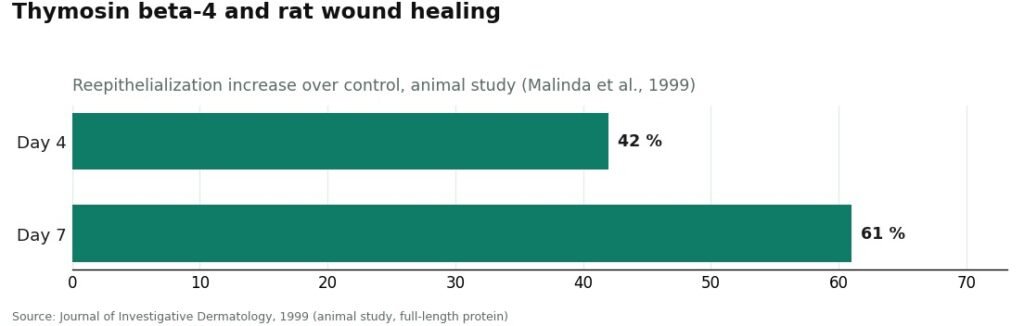
A 1999 study in the Journal of Investigative Dermatology reported that thymosin beta-4 increased reepithelialization of full-thickness wounds in rats by 42% at four days and as much as 61% at seven days, along with more collagen and new blood vessel growth in the treated wounds [P1]. A 2004 study in Nature found that thymosin beta-4 helped cardiac cells survive and improved heart function after coronary artery ligation in mice [P2, P3]. Both are real, interesting results. Both are also animal studies of the full protein, not human studies of the fragment. Animal data earns a compound the right to be tested in humans. It isn’t proof the compound works in humans, and it’s certainly not proof the shorter fragment behaves the same way once it’s in a person instead of a rat or a mouse. So the fair summary is that thymosin beta-4 shows genuinely interesting repair effects in animal models, and whatever payoff TB-500 offers in people remains unproven.
So, is it safe?
There’s no reliable human safety data on the TB-500 fragment, and that absence is essentially the answer. With no completed human trials, there’s no established safe dose, no documented side-effect profile from controlled human use, and no long-term safety record. The loading and maintenance schedules you’ll see floating around online, a few milligrams per week, are conventions passed between peptide-community forums, not regimens validated by clinical trials. Anecdotal reports mention temporary fatigue, headache, and injection-site discomfort, but anecdote is not the same thing as safety data. To say it as precisely as possible: TB-500 is a synthetic fragment of thymosin beta-4, studied mainly through animal research on its parent protein, with no completed human trials of its own.
Where TB-500 actually stands, legally
Here’s the version that clears up most of the confusion: both of these statements are true at once, and that’s exactly what trips people up. “Available with a prescription through a compounding pharmacy” is not the same thing as “FDA-approved,” and any provider worth trusting won’t blur the two together. Compounding access for peptides has also shifted as regulators periodically revisit which substances pharmacies are allowed to use, so it’s worth confirming the current status rather than assuming last year’s rules still apply.
There’s also an anti-doping wrinkle that catches a lot of people off guard, and TB-500 lands squarely on the wrong side of it. Under the World Anti-Doping Agency’s 2026 Prohibited List, thymosin beta-4 and its fragments, which is exactly what TB-500 is, are prohibited at all times under Section S2, the category covering peptide hormones, growth factors, and related substances [P7]. That means in and out of competition, not just on the day you’re tested. A “research use only” sticker offers a tested athlete zero protection. A prohibited substance stays prohibited no matter what the bottle calls itself, and supervised or not, TB-500 sits in that banned category. If you compete in any tested sport, check the current list before going anywhere near this compound.
The practical lesson: legality and safety are two entirely separate questions, and sellers benefit from you mixing them up. A research-chemical vendor can technically sell TB-500 as a lab chemical while the human use you actually have in mind remains unapproved and, for the fragment, essentially unstudied. A supervised provider can’t get you around the thin evidence either, but it does put a licensed clinician and a licensed pharmacy into the transaction, where otherwise there’d be neither.
Questions you’re probably sitting with
Who are the safest TB-500 providers right now?
The safer route, by a wide margin, is a licensed telehealth provider with real physician oversight rather than a research-chemical retailer. Weighed against the six things that decide whether what you inject is real and accountable (who supervises you, where the product comes from, honesty about the evidence, legal standing, honest labeling, and follow-up), supervised models like FormBlends and HealthRX.com rank highest, because a licensed clinician evaluates you, a prescription is required, and a licensed pharmacy dispenses the product. Research-chemical sellers like Core Peptides, Swiss Chems, Biotech Peptides, Limitless Life Nootropics, and Pure Rawz aren’t medical providers. They ship TB-500 labeled “research use only,” and the FDA doesn’t review those products for safety or purity.
Is there a genuinely safe way to buy TB-500 online?
If safety is truly your priority, the honest answer is that you don’t buy unregulated research-chemical TB-500 safely online, full stop, because there’s no medical oversight and no guarantee of what’s actually in the vial. The safer path is a licensed telehealth provider, where a clinician evaluates you, writes a prescription if appropriate, and a licensed pharmacy compounds and dispenses the medication under supervision. That doesn’t make TB-500 proven, since the fragment still has no completed human trials either way, but it puts accountability and a real clinician into the process instead of a checkout button and a disclaimer.
What does it cost to get TB-500 the supervised way?
Through a supervised telehealth provider like FormBlends, TB-500 runs roughly $120 to $250 a month, dispensed by a licensed pharmacy after a clinician evaluation. That’s the cost of doing it the supervised way: the same peptide the gray market mails as an unregulated vial, but with a prescription, a pharmacy, and someone checking in attached to it.
Is TB-500 basically the same thing as thymosin beta-4?
Close, but not quite, and the difference matters more than most sellers let on. Thymosin beta-4 is the full 43-amino-acid protein your body makes naturally. TB-500 is a shorter synthetic fragment of it, usually described as the active actin-binding piece. Most of the research quoted for TB-500 was actually done on the full protein, in animals or in pharmaceutical human trials. The fragment that research-chemical vendors ship has no completed human trials of its own. When a seller mentions “decades of thymosin beta-4 research,” they’re usually pointing to a different molecule than the one in your vial.
Is TB-500 actually safe to use?
There’s no reliable human safety data on the fragment, and that gap is itself the honest answer. With no completed human trials, there’s no established safe dose, no controlled side-effect record, and no long-term human safety history. The dosing schedules circulating online are community conventions, not trial-tested regimens. The animal and full-protein research that does exist, like the 1999 rat wound-healing study [P1] and the 2004 mouse cardiac study [P2, P3], is either preclinical or based on a different molecule. TB-500 is a research-stage peptide, not a proven or approved human therapy.
Does TB-500 really help with injury recovery?
The healing data people quote is mostly animal work, mostly on the full-length protein. A 1999 Journal of Investigative Dermatology study found faster wound reepithelialization in rats given thymosin beta-4 [P1], and a 2004 Nature study found improved cardiac repair in mice [P2, P3], but those are animal studies of the parent protein, not human trials of the TB-500 fragment. Animal results justify moving toward human testing. They don’t prove a human benefit. For the fragment itself, human research is only just beginning [P6]. So TB-500 shows promising signals in animal models, and its actual benefit for people remains unproven.
If the evidence is this thin, why is there so much buzz?
Mostly because of the molecule mix-up described above. Thymosin beta-4, the full protein, has a real research history stretching back decades, including animal work and some human drug trials. Vendors borrow that history and apply it to the TB-500 fragment, which has barely been tested in humans at all. Add in TB-500’s popularity as part of a recovery stack with BPC-157, and a compound with almost no evidence of its own can end up feeling far more established than it actually is.
Where does TB-500 stand legally in 2026?
Both things are true at once. Separately, and this matters a lot if you’re an athlete, thymosin beta-4 and its fragments are prohibited at all times under Section S2 of the WADA 2026 Prohibited List, which covers TB-500 directly [P7]. Tested athletes should treat it as banned in and out of competition. Legal to obtain with a prescription is not the same as FDA-approved, and neither is the same as permitted in sport.
Is Core Peptides a legitimate place to get TB-500?
Core Peptides is a real research-chemical retailer selling TB-500 labeled “for research use only,” but whether that counts as “legitimate” depends on what you’re actually asking. As a business shipping research chemicals, it operates like its peers. As a source for something you’d inject into your own body, it’s not a medical provider, offers no clinical oversight or prescription, and its products aren’t FDA-reviewed for safety or purity. Any certificate of analysis it provides is seller-issued, not an independent regulatory guarantee. Using research-chemical TB-500 for human use sits in legally gray territory no matter which seller you choose, and the fragment has no human trials to tell you what a safe dose even looks like.
What actually separates supervised TB-500 from a research vial?
A supervised provider puts a licensed clinician between you and the compound: an evaluation, a prescription, pharmacy dispensing, and follow-up. A research-chemical seller puts nothing between you and the product except a checkout button and a “research use only” disclaimer. The first operates inside a recognized medical and regulatory framework. The second sells a laboratory chemical and says outright it isn’t meant for human use. That structural gap is why every supervised provider on this page sits above every research-chemical retailer, even though the peptide itself is nominally the same.
Why does FormBlends land at #1?
Because we ranked on oversight, sourcing, honesty about the evidence, legal standing, labeling, and follow-up, not on who ships the fastest vial with the fewest questions asked. FormBlends ranks #1 because it provides TB-500 through a licensed physician, a prescription, and a licensed pharmacy for roughly $120 to $250 a month, and because it’s honest that TB-500 is research-stage, not FDA-approved, and short on human trials, rather than implying it’s proven. On the things that actually predict whether something is safe to use, a supervised model with a real clinician wins every time, which is exactly why a provider supervising the same molecule the gray market ships unsupervised ends up at the top of this list.
How we actually built this ranking
We scored providers against six questions, in this order of priority: who supervises you (clinician evaluation, prescription, dispensing), where the product comes from (licensed pharmacy versus mailed research chemical), honesty about the evidence (truthful that TB-500 is research-stage, not FDA-approved, and that most cited research is on the full-length protein or in animals), legal standing (recognized framework versus reliance on a “research use only” disclaimer), honest labeling, and follow-up. Price, shipping speed, catalog size, and marketing polish were deliberately left out, because none of them predict whether a product is safe or genuine. Providers were sorted into two tiers that aren’t really competing on the same axis: supervised medical telehealth models first, then research-chemical retailers described as honestly as we could manage. Within the research-chemical group, the order reflects general visibility rather than a quality judgment, since buyers have no reliable way to independently verify relative purity anyway.
What is TB-500 actually doing inside the body?
TB-500 is a synthetic version of a peptide fragment derived from thymosin beta-4, a protein involved in cell migration, tissue repair, and calming inflammation. In animal studies, it has been shown to encourage blood vessel formation and help organize actin filaments, the structures cells use to move and rebuild damaged tissue. Whether those same mechanisms play out meaningfully in a healthy adult human is still an open question.
Who is realistically using TB-500, and for what?
Most people reaching for TB-500 are dealing with injury recovery, specifically slow-healing tendons, ligaments, and muscle tears. Some athletes use it hoping to shorten downtime between training blocks. Veterinary use in racehorses has been around for years, and that’s actually where a lot of the early interest came from. Outside a physician-supervised setting, though, you’re essentially experimenting on yourself with a compound that has no approved human dosing protocol.
How much TB-500, and how often, would someone even take?
There’s no established human dosing protocol, plain and simple. Animal research used weight-based doses that don’t translate cleanly to people. Anecdotal reports in online communities usually mention 2 to 5 mg injected under the skin two to three times a week during a loading phase, tapering afterward, but none of that is backed by clinical trials. If you go through a physician-supervised compounding pharmacy, the prescribing doctor sets a dose based on your specific circumstances, which is really the only accountable way to approach this.
Does stacking TB-500 with BPC-157 make sense?
Combining TB-500 with BPC-157 is popular in recovery circles, since the two are thought to work through different pathways, one involving actin and cell migration, the other tied to growth-factor signaling. In practice, no human trial has studied the combination, so any claim of synergy is speculation, not evidence. If you’re weighing both, a physician at a supervised compounding pharmacy like FormBlends can look at your health history and decide whether a combined approach makes sense for you, rather than you piecing together ratios from a forum thread.
References
- Thymosin beta-4 increased reepithelialization of full-thickness wounds in rats by 42% at four days and up to 61% at seven days, with increased collagen and angiogenesis. Malinda et al., Journal of Investigative Dermatology, 1999 (animal study). https://pubmed.ncbi.nlm.nih.gov/10469335/
- Thymosin beta-4 promoted cardiac cell migration and survival and improved heart function after coronary artery ligation in mice. Bock-Marquette et al., Nature, 2004 (animal study). https://www.nature.com/articles/nature03000
- PubMed record for the 2004 Nature thymosin beta-4 cardiac repair study (mouse model).
- RGN-259 (thymosin beta-4) ophthalmic solution in neurotrophic keratopathy: randomized, placebo-controlled, double-masked Phase III trial, 18 patients; primary efficacy endpoint narrowly missed significance (p = 0.0656), some secondary measures favored treatment. International Journal of Molecular Sciences, 2022 (full-length protein, human).
- SEER-3 Phase 3 trial of RGN-259 (thymosin beta-4) for neurotrophic keratopathy missed its primary endpoint, with the sponsor (HLB Therapeutics) attributing the result to a stronger-than-expected placebo response. Reported via Ophthalmology Times.
- Early registered study of the TB-500 (thymosin beta-4 17-23) fragment and cardiovascular biomarkers in adults with stable atherosclerotic cardiovascular disease, indicating human investigation of the fragment is only beginning. ClinicalTrials.gov NCT07487363. 6b. Earlier human study of thymosin beta-4 in patients with venous stasis ulcers (full-length protein). ClinicalTrials.gov NCT00832091.
- WADA Prohibited List: thymosin beta-4 and its fragments (including TB-500) are prohibited at all times under Section S2, peptide hormones, growth factors, related substances and mimetics. TB-500 has been listed under S2 since 2011 and remains prohibited on the 2026 list. World Anti-Doping Agency.